Why Agreements Become a Second System After the Deal Closes
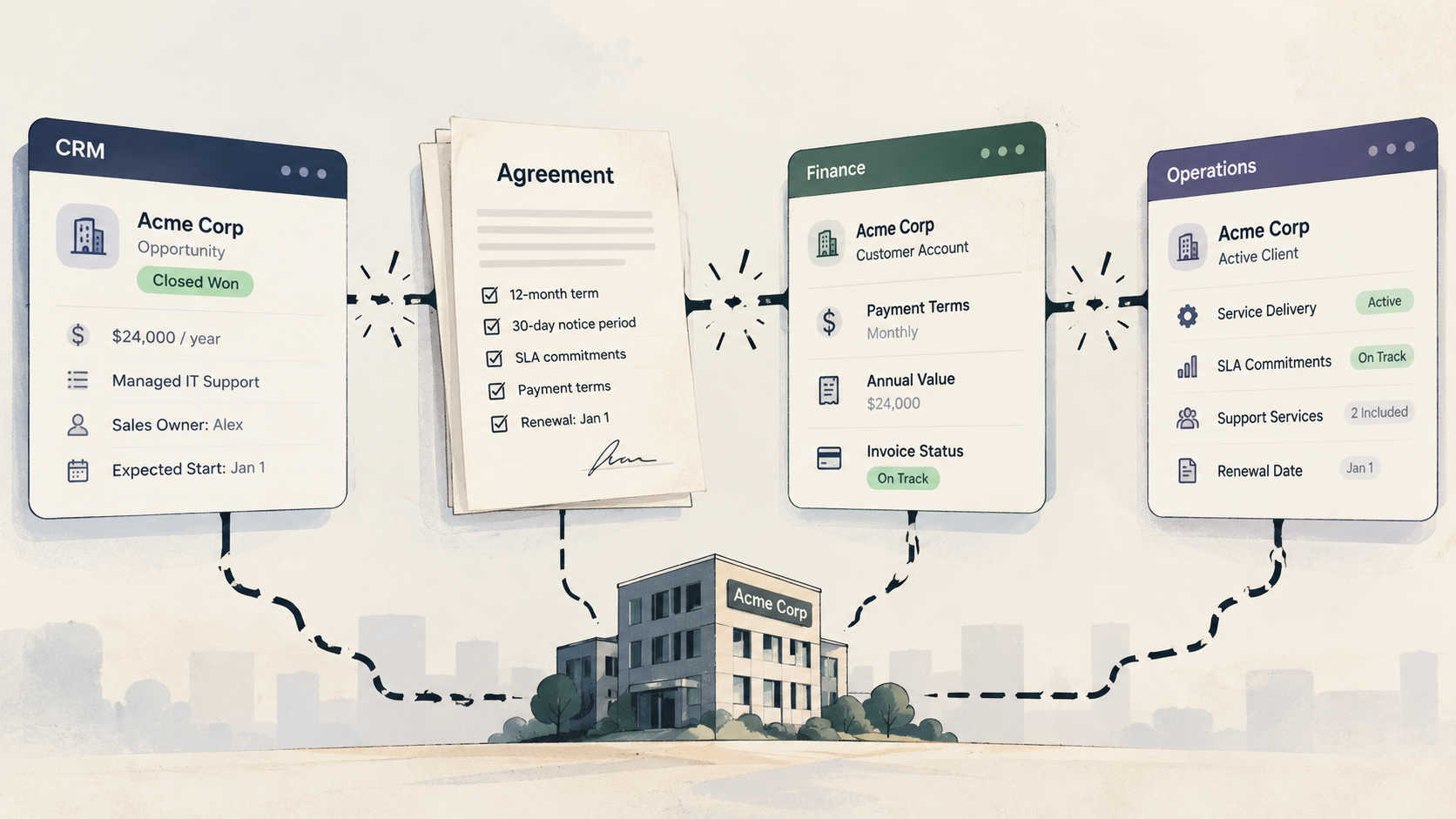
The deal lives in the CRM. The agreement lives in a PDF. The renewal lives in someone's calendar. And suddenly, one customer relationship is spread across four different places.
- 1.Your IT Service Company Has Agreements. But Who Actually Operates Them?
- 2.Why CRM and CLM Shouldn't Be Separate Worlds
- 3.Deal to Agreement: Where the Operational Gap Actually Begins
- 4.Why Agreements Become a Second System After the Deal Closes
- 5.What If CRM, CLM, and Business Operations Worked as One?
- 6.I Built AgreeOps to Connect Deal to Done
Why Agreements Become a Second System After the Deal Closes
- The deal is in the CRM.
- The contract is in Google Drive.
- The signed PDF is sitting in someone's inbox.
- The renewal date is on a calendar.
- And the payment terms?
Someone probably knows.
This is surprisingly normal.
A company can have a perfectly organized CRM and still have a messy agreement management process. Because once a deal is closed, the agreement often becomes a second system.
Here's a simple example
Imagine an IT services company signs a one-year agreement with a client.
During the sales process, everything is tracked in the CRM:
Deal value: $24,000/year
Services: Managed IT support
Start date: January 1
Sales owner: Alex
The deal is marked Closed Won. Then the agreement gets created.
The contract contains additional details:
- Monthly payment terms
- 12-month term
- 30-day termination notice
- Specific SLA commitments
- Two included support services
- Annual renewal
The contract gets signed and stored.
Now jump forward ten months.
The sales team sees the customer in the CRM. The contract team has the agreement in a folder. Finance has payment information in its accounting system. The operations team knows about the SLA.
But who is looking at the whole picture?
That's where things get uncomfortable.
The contract isn't the problem
It's tempting to blame PDFs, spreadsheets, or contract management software.
But the real problem is bigger.
- The company has created multiple versions of the same customer relationship.
- The CRM knows the customer as a deal.
- The contract system knows the customer as an agreement.
- Finance knows the customer as an account.
Operations knows the customer through their service commitments.
Each system is correct on its own. But none of them necessarily knows the entire story.
And this gets worse at renewal time
Let's go back to our example.
The agreement renews on January 1. The contract requires 30 days' notice. So someone should probably start thinking about the renewal around December 1. But where does that reminder live? Maybe inside a CLM. Maybe inside a spreadsheet. Maybe in a calendar. Maybe nobody has created the reminder yet.
Meanwhile, the CRM still says:
Acme — Customer — $24,000
Nothing looks wrong. The deal is closed. The customer is active. Everything appears fine. Until someone realizes the renewal is two weeks away.
This isn't just an IT company problem
The same pattern appears across many businesses.
- Agencies have client retainers.
- Consultancies have service agreements.
- Construction companies have project contracts.
- Software companies have subscriptions and enterprise agreements.
The details are different, but the underlying problem is similar:
The relationship continues, while the systems become disconnected.
The contract doesn't stop mattering after signature.
In many ways, that's when it starts mattering most.
CRM and CLM each solve part of the problem
CRM is great at managing the customer and the commercial relationship.
CLM is useful for managing the contract lifecycle — creation, review, approval, signature, and storage.
But there is a space between:
"We won the deal."
and
"We're successfully operating the agreement."
That space is where things like obligations, renewals, commitments, payments, and responsibilities live.
And when that space isn't connected to the rest of the customer workflow, people fill the gap manually.
- Spreadsheets.
- Emails.
- Calendar reminders.
- Slack messages.
- Internal notes.
That's how a second system quietly appears.
The goal isn't another place to store contracts
The better question is:
Why should the agreement become a separate world at all?
A signed agreement should carry the context of the deal forward. The customer shouldn't become a different object just because the sales stage ended. The commercial terms shouldn't disappear into a PDF. And the commitments shouldn't depend on someone remembering to check a document. The agreement is part of the same customer relationship.
It just represents a different stage of it.
The deal starts the relationship.
The agreement defines it.
Operations deliver it.
The systems should reflect that journey too.
That's the real problem behind agreement operations.