I Built AgreeOps to Connect Deal to Done
CRM manages the deal. Contracts manage the agreement. Finance handles payments. Operations handles delivery. I built AgreeOps to bring that journey together — from the first deal to the work that follows the signed agreement.
- 1.Your IT Service Company Has Agreements. But Who Actually Operates Them?
- 2.Why CRM and CLM Shouldn't Be Separate Worlds
- 3.Deal to Agreement: Where the Operational Gap Actually Begins
- 4.Why Agreements Become a Second System After the Deal Closes
- 5.What If CRM, CLM, and Business Operations Worked as One?
- 6.I Built AgreeOps to Connect Deal to Done
I Built AgreeOps to Connect Deal to Done
I kept thinking about one question:
What happens to a customer relationship after the contract is signed?
Not legally. Not theoretically.
Practically.
Who knows what was promised?
Who is watching the renewal?
Where are the payment terms?
What still needs to be delivered?
What did the client agree to do?
What happens when something changes?
The more I looked at this workflow, the more I felt that the agreement itself should be the centre of it.
That's why I started building AgreeOps.
The idea behind AgreeOps
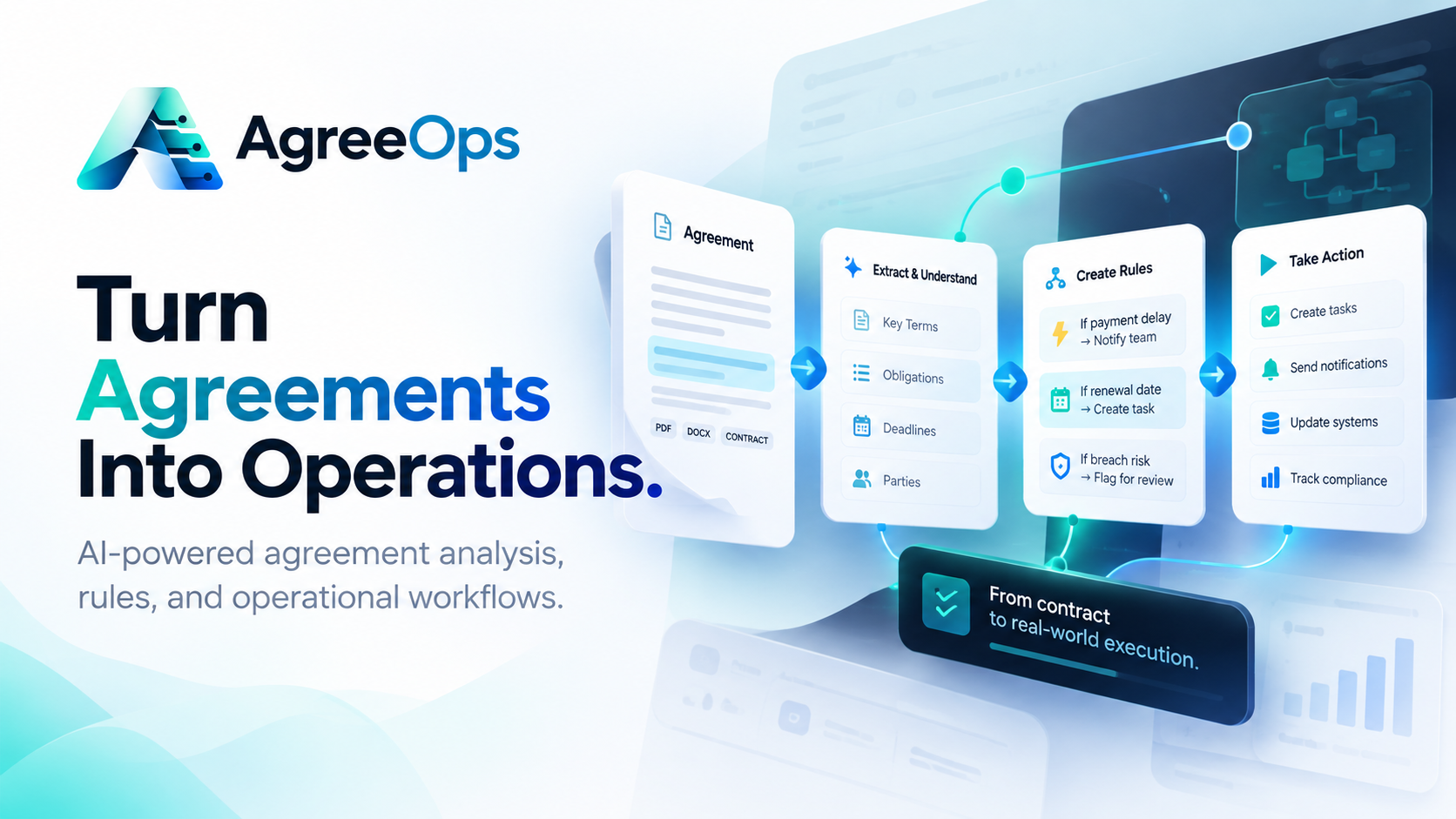
AgreeOps is an agreement operations platform for businesses that sell services through ongoing agreements.
The basic idea is:
Turn the agreement from a document you store into a relationship you operate.
That means the agreement isn't just a PDF.
It can connect the customer, commercial terms, payments, obligations, approvals, signatures, activity, and renewals around the same relationship.
Let's look at one agreement
Say an IT services company signs a one-year agreement with a client for $24,000.
The agreement says:
- $2,000 monthly payment
- Managed IT support
- 12-month term
- 30-day termination notice
- Specific service commitments
- Renewal on January 1
On its own, that's just contract information.
But now turn it into an operating relationship.
The company can see the client.
It can see the active agreement.
It can see what the client is paying.
It can track the commitments attached to the agreement.
It can see when the agreement needs attention.
And when the renewal approaches, the team doesn't have to rediscover the relationship from scratch.
That's the difference I'm trying to create.
What changes for the team?
Imagine someone from the company opens that client six months after signing.
Instead of asking:
"Where's their contract?"
they can start with:
"What's going on with this agreement?"
They can see the commercial terms.
They can see the agreement status.
They can see payment information.
They can see outstanding actions and obligations.
They can see important dates.
They can see the history of the relationship.
That changes the workflow from document retrieval to business operation.
A simple renewal example
Let's say the agreement expires on January 1 and requires 30 days' notice.
Without a structured workflow, someone has to remember that.
With AgreeOps, the renewal becomes part of the agreement's lifecycle.
As the date approaches, the team knows:
Agreement: Acme Managed IT
Renewal: January 1
Notice period: 30 days
Annual value: $24,000
Status: Active
Now the team has time to make a decision.
Renew?
Renegotiate?
Expand the services?
End the relationship?
The important part isn't the reminder itself.
It's that the reminder is connected to the actual agreement and its commercial context.
And the money matters too
Consider what happens when a business manages 50 or 100 active service agreements.
Each agreement can represent recurring revenue.
A missed renewal can mean missed revenue.
A forgotten payment term can create unnecessary follow-up.
A commitment that isn't tracked can create delivery problems.
A contract that nobody reviews before renewal can become a missed opportunity to expand the relationship.
So agreement operations isn't only an administrative problem.
It can affect revenue, cash flow, customer retention, delivery, and time.
That's why I don't think agreements should live in isolation from the rest of the business.
What AgreeOps is trying to bring together
The product is being built around the complete agreement lifecycle:
Client → Deal → Agreement → Approval → E-Signature → Payment → Obligations → Delivery → Renewal
The goal isn't to build another giant system that tries to replace every piece of software a company already uses.
It's to create a place where the agreement and everything that happens because of it can stay connected.
That's the core idea.
Why this matters for smaller service companies
Large companies can afford teams dedicated to contracts, operations, finance, and customer success.
A smaller IT services company might have the founder handling sales, someone managing delivery, another person chasing payments, and everyone sharing responsibility for renewals.
For them, operational complexity arrives surprisingly early.
You don't need thousands of contracts to have a problem.
You just need enough customers that remembering everything manually stops working.
That's where a structured agreement operations workflow can become useful.
So, why AgreeOps?
I didn't want to build another place where companies simply upload contracts.
I wanted to build around a different question:
What if the agreement was the operating record of the customer relationship?
The thing that connects what was sold, what was signed, what is being paid, what needs to happen, and what comes next.
That's what I'm building with AgreeOps.
From deal to agreement.
From agreement to action.
From action to done.
That's Agreement Operations.