What Infrastructure Does an AI Agent Actually Need?
AI agents are getting better at using tools. But real work needs more than tools — it needs a place to execute, persist, experiment, and operate. So what should an AI agent actually have?
- 1.Why AI Agents Need More Than Tools
- 2.Why AI Agents Need Their Own Environment
- 3.Tools vs Environments: What AI Agents Actually Need
- 4.What Infrastructure Does an AI Agent Actually Need?
We've spent a lot of time making AI agents smarter.
- Better models.
- Better reasoning.
- Better tools.
- Better MCP servers.
And it's working.
AI agents can browse websites, write code, use APIs, work with GitHub, run commands and interact with all kinds of software.
But there's a question we don't talk about enough:
What does an AI agent actually need to do real work?
- Not answer a question.
- Not call one API.
- I mean real, messy, multi-step work.
Because once you look at it that way, you realize something pretty quickly:
An AI agent needs infrastructure.
A tool is not an environment
Let's start with the simplest distinction.
A tool gives an AI agent a capability. A terminal lets it run commands. GitHub lets it interact with repositories. An API lets it interact with another service. Useful? Absolutely.
But imagine giving a developer a terminal, GitHub and 20 APIs and then taking away their computer.
They technically have access to everything. They just don't have a place to work.
That's the difference between tools and an environment.
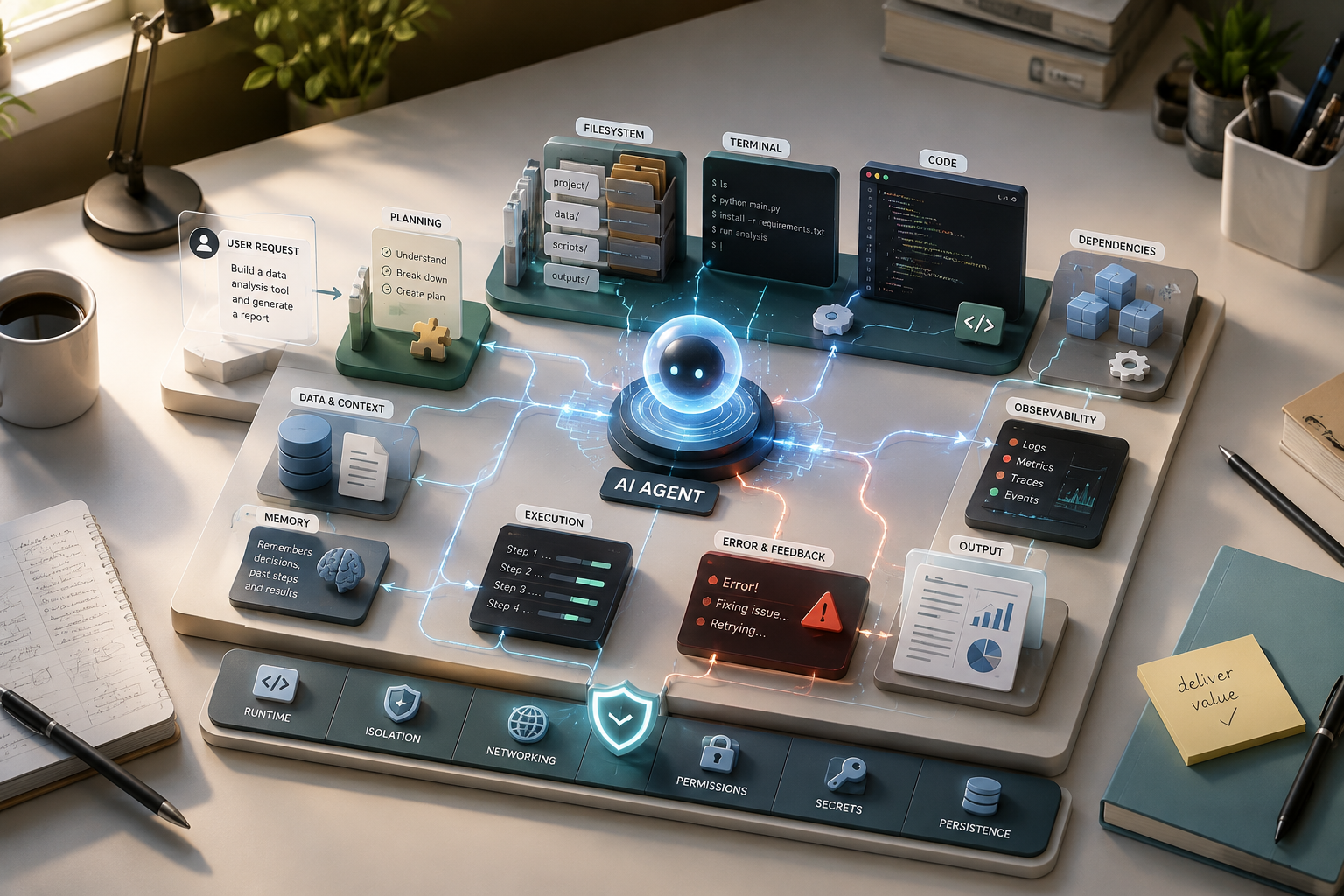
An AI agent environment is the place where those capabilities come together. And once an agent starts doing serious work, that environment becomes surprisingly important.
So what actually belongs inside an AI agent environment?
There isn't one perfect answer. It depends on what the agent is supposed to do.
But if we're talking about an agent that needs to operate independently, I think there are a few pieces that start becoming hard to avoid.
1. A filesystem
This sounds boring. It's not. Files are where work lives. Source code, configuration, logs, generated outputs, datasets, documentation — all of it needs somewhere to exist.
Without a filesystem, an agent can perform actions, but it's difficult for it to build anything that persists beyond the current interaction.
2. A runtime
If an agent needs to actually execute software, it needs a runtime.
Maybe that's Python. Maybe Node.js. Maybe Docker. Maybe something completely different.
The important part isn't the specific technology. It's that the agent has somewhere to execute what it creates or modifies.
Writing code is one thing. Running it is another.
3. Dependencies
Real software rarely works in isolation.
Install a package. Update a library. Use a specific version. Resolve a conflict.
Try again.
This is normal developer work.
An environment gives an AI agent the ability to manage that context instead of treating every task like a clean slate.
4. Persistence
This one might be the biggest.
Imagine an agent works on something for three hours.
It creates files. Changes configuration. Runs experiments. Finds a bug. Then the environment disappears.
Next time, it starts from zero.
That's not particularly useful.
A persistent AI agent environment lets work survive beyond a single session.
The agent can come back. Continue.
Inspect what it did earlier. Pick up where it stopped. That's a very different model of automation.
5. Networking
Modern software doesn't live alone.
Agents may need to interact with GitHub, cloud services, package registries, APIs, databases or internal systems.
So an AI environment needs some form of network access.
But there's an important catch:
Access shouldn't mean unlimited access.
Which brings us to one of the harder parts.
6. Credentials and permissions
If an AI agent can actually do things, it will eventually need credentials.
And that's where "just give the agent access" starts sounding like a terrible idea.
- What can it access?
- What can it modify?
- Which credentials can it use?
- For how long?
- Can it deploy?
- Can it delete?
- Can it access production?
These aren't just AI questions. They're infrastructure questions.
The more capable agents become, the more important identity, permissions and isolation become.
7. Isolation
This is probably one of the biggest differences between giving an AI access to your laptop and giving it a dedicated environment.
You don't necessarily want an autonomous agent experimenting inside your personal machine. One bad command shouldn't affect everything else. A proper AI agent environment should have boundaries.
The exact implementation can vary — containers, virtual machines, sandboxes and other isolation techniques all have trade-offs.
But the principle is simple:
Let the agent work without letting one mistake take down everything around it.
8. Observability
There's another problem that becomes obvious once agents start running for longer periods:
What the hell is it doing?
If an agent runs a task for an hour, you need some way to understand what happened.
- Logs.
- Execution history.
- Errors.
- Resource usage.
- Task state.
- Maybe even a record of important actions.
The more autonomous the system becomes, the less comfortable "trust me, the agent handled it" sounds.
You need visibility.
Put everything together
Now look at the pieces again:
Filesystem Runtime Dependencies Persistence Networking Credentials Isolation Observability
None of these are particularly revolutionary on their own. That's the interesting part.
We're not inventing some magical new infrastructure. We're taking things developers and operators have used for years and asking:
What does this look like when the primary user is an AI agent?
And that's a much more interesting question.
The environment becomes part of the agent
This is where I think the conversation around AI agents starts changing.
Today, we often think about an agent like this:
AI model → tools → result
But for more capable systems, the architecture starts looking more like:
AI model → client → environment → tools → execution → state
The environment isn't just somewhere the agent happens to run. It becomes part of the agent's ability to operate.
Give the same model ten tools but no persistent environment, and you get one kind of system.
Give it a persistent, isolated environment with a runtime, filesystem and controlled access, and you get something much closer to an AI operator.
That's a pretty significant difference.
And this is where AI automation gets interesting
A lot of AI automation today is basically:
trigger → AI → API → done
That's useful.
But there are problems that don't fit neatly into that pattern.
- Software development.
- DevOps.
- Research.
- Data analysis.
- Infrastructure management.
- Long-running projects.
Tasks where the agent needs to inspect something, make a change, test it, notice that it failed, try another approach and continue later. Those aren't really single actions. They're workflows that need an environment.
And I think that's one of the infrastructure problems AI automation will have to solve.
We're exploring this at Causly Lab
This is one of the questions we're exploring while building Causly Hosted:
What would it look like if an AI client had a persistent environment of its own?
Not just another collection of tools. Not another chat interface.
An actual place where the work can happen.
The goal isn't to make AI autonomous for the sake of it.
It's to give AI systems the infrastructure they need to become genuinely useful operators — while keeping humans in control.
Because if AI agents are going to move from answering questions to doing work, they will eventually need somewhere to do that work.
And maybe that "somewhere" becomes one of the most important pieces of AI infrastructure we build.
This is only the beginning.
We're building and testing these ideas at Causly Lab.
And Causly Hosted is our attempt to turn the idea of an AI-native environment into something you can actually use.