Causly Server: What If Your AI Agent Had Hands?
AI agents already know how to reason and write code. The problem is everything they still can't reach. Causly Server gives MCP-compatible agents a unified way to work across your development environment—from files and databases to infrastructure, deployment, communication, and more.
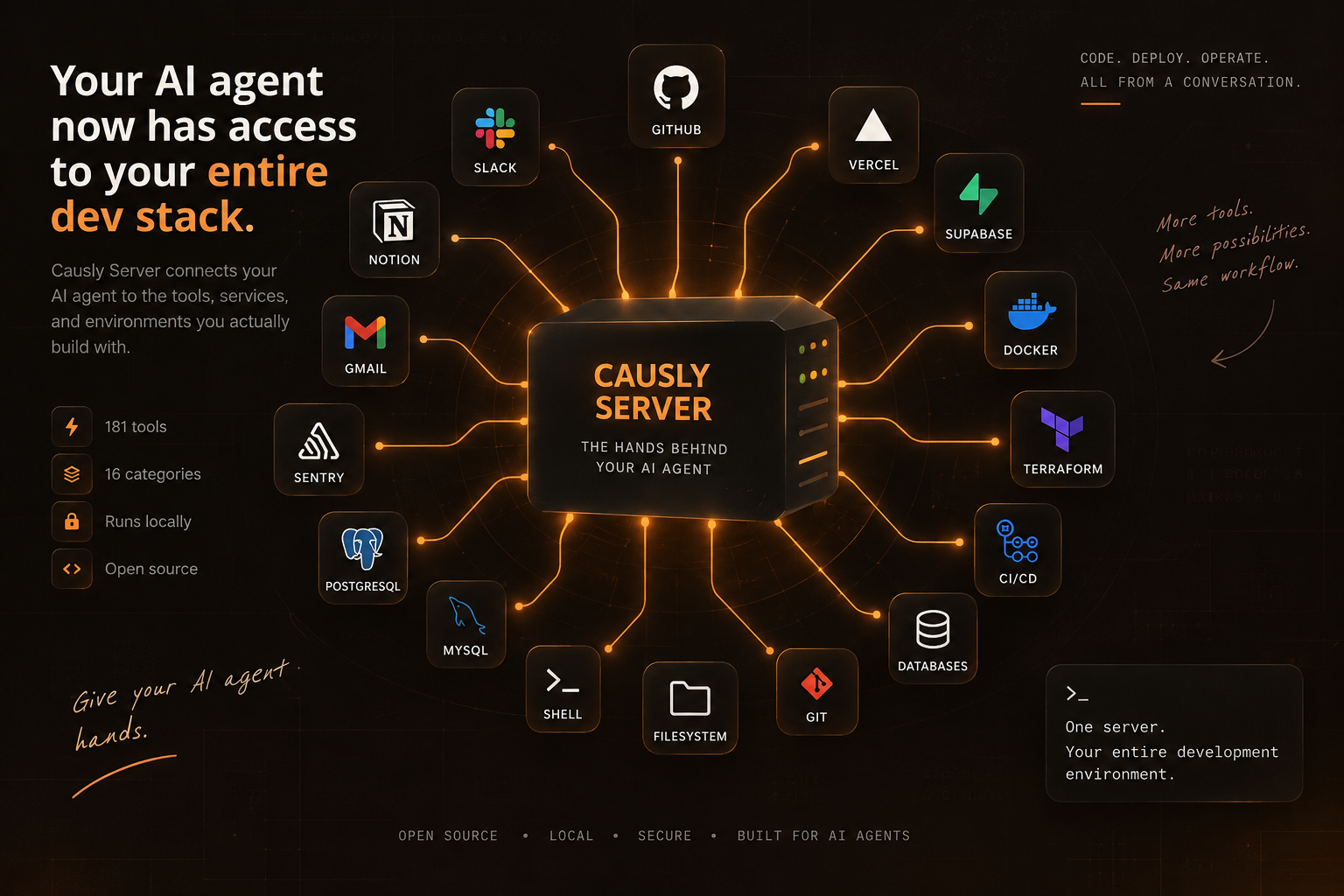
Causly Server: What If Your AI Agent Had Hands?
AI agents can write code.
They can reason about a problem, edit files, call APIs, inspect a repository, and even plan out an entire feature.
But there is a weird gap between being able to do something and actually being able to work on a software project.
The moment an agent needs to do something outside the code editor, the context starts breaking apart.
- It needs the repository.
- Then GitHub.
- Then Supabase.
- Then Docker.
- Then Terraform.
- Then Slack.
- Then Notion.
- Then Vercel.
- Then Sentry.
And suddenly, the agent isn't really working on the project anymore.
It's jumping between tools.
That's the problem Causly Server is trying to solve.
What if your agent had hands?
Causly Server is an open-source, local MCP server that brings a collection of software development tools behind one interface, allowing MCP-compatible AI agents to work across the development lifecycle without constantly switching contexts.
The problem isn't a lack of tools
AI agents already have access to thousands of tools. The problem is that those tools usually live in separate places.
Imagine you're asking an agent:
"Fix this bug, update the database, deploy the change, and tell the team what happened."
A human developer might naturally move through:
Repository
   ↓
Code
   ↓
Database
   ↓
Tests
   ↓
Deployment
   ↓
Monitoring
   ↓
Communication
An AI agent needs access to all of those environments too. Without that access, the agent can write the code but can't finish the job.
- It can suggest the SQL but can't necessarily execute it.
- It can explain how to deploy but can't necessarily deploy.
- It can write a Slack message but can't necessarily send it.
This creates a subtle problem: The intelligence exists, but the hands are missing.
Causly Server gives the agent one place to work
Causly Server is built around the Model Context Protocol (MCP).
Instead of connecting an agent to every tool independently, Causly Server acts as a unified MCP server that exposes the capabilities an agent needs.
The basic idea looks like this:
The important part isn't simply the number of tools. It's the unified interface.
The agent doesn't need a completely different mental model every time it needs to perform another part of the job. It asks Causly Server for the capability it needs.
Causly Server routes that request to the appropriate tool.
You don't need to use a specific agent
Causly Server isn't an AI agent. And it isn't tied to one model.
The idea is simple: Use whatever MCP-compatible agent you already like.
Claude. Cursor. Codex.
Or another agent that supports MCP.
Causly Server sits underneath that agent and provides the capabilities. That's an important distinction.
We're not trying to replace your agent.
We're trying to give your agent more useful hands.
One agent, many parts of the project
Consider a simple feature request:
"Add user authentication, update the database schema, deploy it, and notify the team."
With the appropriate Causly Server tools available, an agent can move through the project instead of stopping at every boundary.
It can:
- Inspect the existing project.
- Modify the relevant files.
- Work with Git.
- Inspect or interact with the database.
- Run development commands.
- Build or test the application.
- Work with Docker where required.
- Handle infrastructure-related operations.
- Deploy through the available deployment tooling.
- Check relevant errors or project state.
- Update documentation.
- Send a message to the team.
The interesting part isn't that each individual action is revolutionary.
Most of these things already existed.
The difference is that the same agent can move through them as part of one workflow.
That's where the environment starts becoming important.
Lazy loading matters
One concern with a system containing a large number of tools is obvious:
What happens when you give an agent hundreds of tools?
You don't want to dump every possible capability into the model context for every task.
Causly Server is designed around lazy tool discovery/loading.
There can be many capabilities available, but the agent doesn't need to actively reason about every tool at every moment.
When it needs something, the relevant capability can be discovered and used.
This matters because agent context is valuable.
The goal isn't:
"Give the model every tool we have."
The goal is:
"Give the model the capability it needs when it needs it."
What can Causly Server actually touch?
The project currently brings together capabilities across several parts of the software lifecycle.
That includes things like:
- Files and project management
- Git and GitHub
- Slack
- Notion
- Gmail
- Supabase
- PostgreSQL / SQL
- Docker
- Terraform
- Vercel
- Security and credential handling
- Workflow tooling
- Project intelligence
- CI/CD-related operations
- And other development capabilities
The exact toolset will continue to evolve.
Some integrations that are important to the bigger vision—such as Jira, Linear, Kubernetes, and additional cloud tooling—still need to be added.
And that's intentional.
Causly Server is an open-source project that is still being built.
It still runs on your machine
This is probably the most important boundary to understand.
Causly Server OSS does not currently provide its own isolated cloud environment for your agent.
It runs in your environment.
That means the agent's capabilities ultimately depend on what you've configured and what your machine and connected services allow it to access.
- Your credentials are yours.
- Your environment is yours.
- Your infrastructure is yours.
- You configure the services you want the server to interact with.
This also means Causly Server isn't pretending to be some magical autonomous computer floating somewhere in the cloud.
It's a local tool layer that gives an MCP-compatible agent access to your development environment.
Destructive actions don't just happen silently
Giving an AI agent access to your machine is powerful. It also means you need boundaries.
Causly Server treats potentially destructive operations differently.
For example:
docker rundocker ps- Terraform deployments
- Terraform destroy operations
- Other operations that can materially change your environment
can require confirmation before execution.
The agent can ask:
"This operation will make a change. Do you want me to continue?"
You can approve it.
Or, when appropriate for your workflow, configure an operation to always be accepted.
The point isn't to make agents powerless.
It's to make their capabilities visible and controllable.
Causly Server is not perfect
And this is where I think an open-source project should be honest.
There are still real limitations.
1. It doesn't provide its own isolated environment yet
Today, Causly Server works inside the user's environment.
A future version may provide stronger isolation and dedicated execution environments, but that isn't what the current OSS project promises.
2. Setup is still manual
Right now, using the OSS version requires forking the repository, cloning it locally, configuring the environment variables and credentials, and connecting it to your MCP-compatible agent.
There isn't a polished one-command installer yet.
That's something I want to improve as the project grows.
3. Some operations intentionally aren't fully automated
For example, certain cloud database operations may require you to perform the final operation yourself instead of allowing the agent to directly execute everything.
Sometimes a boundary is more useful than another button.
4. Some workflow tools can consume more tokens
Certain CLI and workflow-oriented capabilities involve multiple tools and repeated operations.
That can make some tasks more token-intensive than a simple one-tool interaction.
5. The tool ecosystem is still growing
There are integrations that aren't here yet.
- Linear.
- Jira.
- Kubernetes.
- More cloud infrastructure capabilities.
- More development workflows.
These are exactly the kinds of areas where contributors can make the project significantly better.
Why make it open source?
Because I don't think an agent environment should be a black box.
There are too many interesting questions here.
How should an agent interact with a local machine? What should it be allowed to execute? How should destructive operations be handled? How should credentials be exposed? How should tools be discovered? How much context should an agent receive? How should an agent move from writing code to deploying it?
And eventually:
What should an environment designed specifically for AI agents actually look like?
I don't think one person should answer all of those questions alone.
That's why Causly Server is open source.
The project should grow with developers who actually use agents to build things.
The bigger idea
I don't think the future of AI development is just about making models smarter.
A smarter model is useful.
But a smart model that cannot interact with the environment where the work actually happens is still limited.
The interesting combination is:
Reasoning + tools + environment + boundaries.
That's what Causly Server is exploring.
- Not another AI agent.
- Not another coding assistant.
- Not another collection of disconnected integrations.
A common environment through which different AI agents can actually work.
What if your agent had hands?
That's the question behind Causly Server.
You choose the agent.
You choose the model.
You choose your environment.
You choose the services you connect.
Causly Server simply gives the agent a unified way to interact with them.
So instead of:
"AI, tell me how to do this."
the goal becomes:
"AI, go do this."
And when the work touches something destructive or sensitive, the human can still stay in the loop.
That's the direction I'm building toward.
Use whatever agent you want.
Give it Causly.
Let it build, manage, automate, deploy, and observe your software.
Because maybe the next step for AI agents isn't just giving them better brains.
Maybe it's giving them hands.