Causly Agent Environment
Causly Agent Environment is the environment we're building around AI agents so they can do real work end to end—not just generate code or call a few tools. Use the agent you already like, give it Causly, and let it build, deploy, manage, and observe.
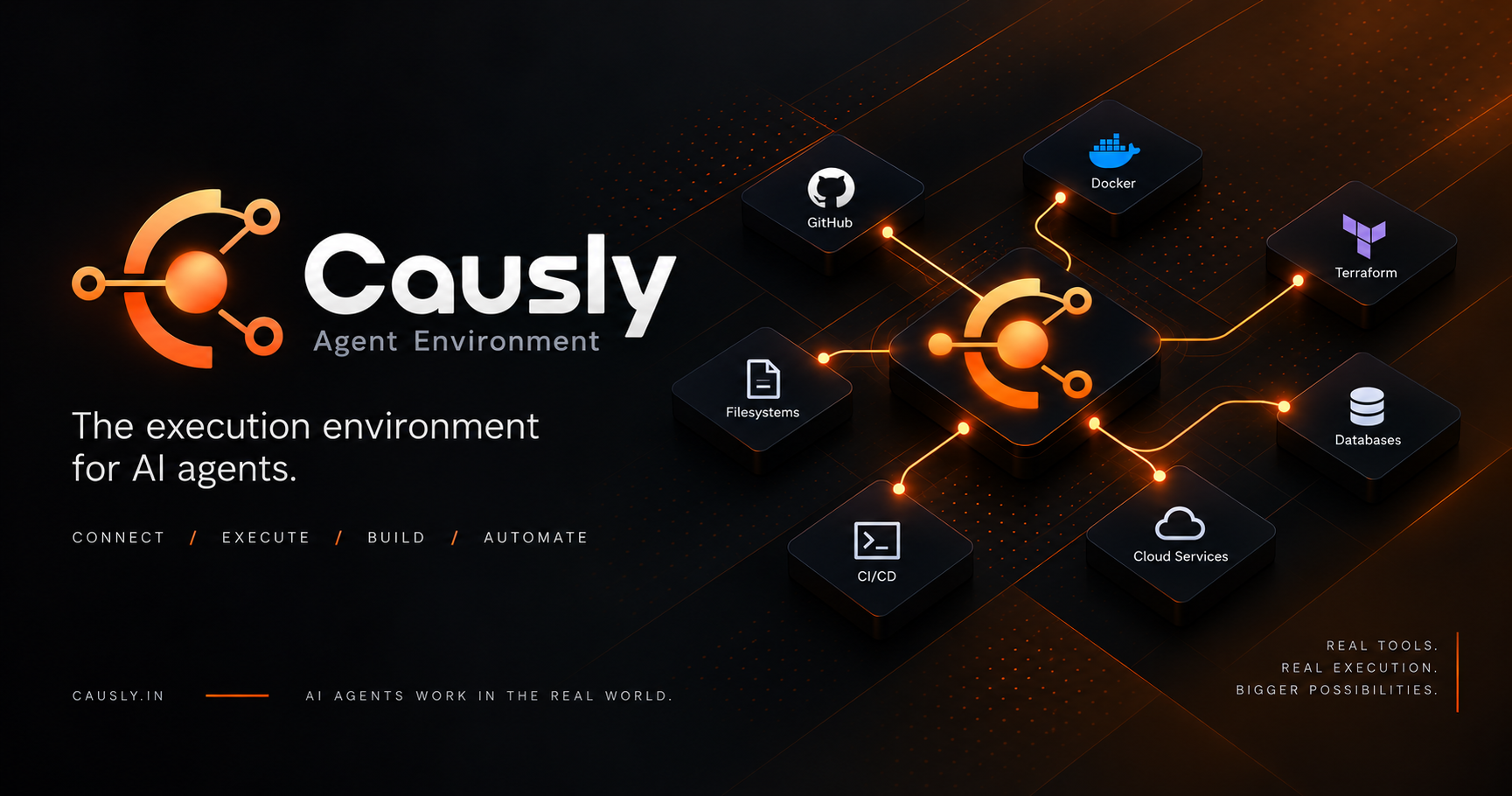
Causly Agent Environment: Give Any AI Agent an Environment to Do Real Work
Use whatever agent you like. Give Causly, and it will build, automate, deploy, manage, and observe.
That is the simplest way to describe what we're building with Causly Agent Environment. The idea didn't start with building another AI agent. There are already plenty of them.
You can use Claude, Cursor, a custom agent, or whatever comes next. The interesting question isn't necessarily which agent should you use?
The question is: What does that agent need around it to actually do real work?
That's where Causly comes in.
The idea behind Causly Agent Environment
An AI agent can reason about a task, write code, call tools, and make decisions. But giving an agent intelligence doesn't automatically give it a place to work.
We wanted to approach this differently.
Instead of building an agent and asking everyone to change their workflow around it, we're building an environment that can work with the agent they already choose.
Think of it almost like giving an agent a pair of hands and a house.
MCP tools are the hands.
They let an agent interact with GitHub, databases, cloud platforms, communication tools, and other systems.
The runtime is the house.
It gives the agent somewhere to actually execute code, work with files, run processes, install dependencies, and perform tasks in an isolated environment.
Together, these capabilities allow an agent to move beyond simply generating an answer and start actually doing the work.
But Causly Agent Environment goes further than tools and runtime.
The long-term idea is to give an agent everything it needs to participate in an entire workflow—from understanding a project to building something, deploying it, managing it, and observing what happens afterwards.
Why did we start thinking about this?
Working with AI coding agents makes one thing obvious pretty quickly. An agent can be extremely capable and still be limited by its environment.
You might give it access to one tool, then another. You might create a sandbox for it. You might connect a database. You might give it access to GitHub.
And suddenly you're building an entire collection of systems around the agent.
That made us ask a different question: What if the environment itself was designed for agents?
Rather than repeatedly modifying an agent's architecture whenever it needs a new capability, the environment could provide those capabilities externally.
The agent stays the agent. The environment evolves around it.
That became the basic idea behind Causly Agent Environment.
What is Causly Agent Environment?
Causly Agent Environment is a software environment designed to let AI agents perform real-world work end to end.
- It is not another AI model.
- It is not another chatbot.
- And it is not tied to a single agent.
The goal is to make Causly work with different kinds of agents—popular agents such as Claude or Cursor, as well as custom agents built by developers.
At a high level, the environment brings together several pieces:
This architecture is intentionally modular. Not every piece has to be provided by one monolithic application.
The environment is the layer that connects these capabilities together so an agent can use them as part of its work.
The pieces of Causly Agent Environment
1. Causly Server
The first major piece is Causly Server.
Causly Server provides agents with access to external systems and capabilities through tools and integrations. An agent might need to work with GitHub, databases, cloud infrastructure, Slack, Notion, deployment systems, or other services.
Instead of building every capability directly into the agent, Causly Server exposes these capabilities to it.
There are two directions here:
Causly Server OSS gives developers an open-source way to run and extend this infrastructure themselves.
Causly Hosted is the managed version, where the infrastructure can be provided without requiring the user to operate everything themselves.
The OSS server is already complete, while the Hosted version is currently being built.
Causly Server is essentially one part of the agent's hands.
2. Agent Runtime Environment
Tools let an agent interact with external systems. But an agent also needs somewhere to work.
That's the job of the Agent Runtime Environment.
The runtime is the execution layer where an agent can work with things such as:
- Files and directories
- Source code
- Shell commands
- Processes
- Dependencies
- Ports
- Code execution
- Isolated environments
The runtime will exist in both open-source and hosted forms.
The idea is simple: when an agent needs to perform actual work, it shouldn't have to depend on the user's machine or an improvised execution setup.
It gets an environment designed for that work.
3. Project Intelligence
Doing a single task is one thing. Working on a project for weeks or months is another.
A useful agent needs to understand more than the current prompt.
It needs to know what the project is, what has already happened, what decisions were made, what the current state is, and what needs to happen next.
That's where Project Intelligence comes in.
The long-term Causly environment is intended to maintain structured project context around things like:
- Requirements
- Goals
- Tasks
- Decisions
- Changes
- Issues
- Validation
- Project state
- History
This gives agents something much more useful than a giant block of conversation history.
It gives them project context.
4. Causly Desktop / IDE
This is probably the biggest part of the long-term vision. We're still exploring exactly what the final product should look like.
It could take the form of an AI-native IDE, a desktop application, or a broader workspace where humans and agents work together.
The important part isn't the UI. The important part is the job it needs to accomplish.
The goal is to provide a place where an agent can participate in the complete software lifecycle:
Plan → Build → Test → Debug → Deploy → Manage → Observe
A developer shouldn't have to jump between ten different interfaces just to get an agent to finish a project.
The Causly environment should eventually make it possible for a user to give an agent a larger objective and let the system coordinate the work around it.
The exact tools, connectors, and product boundaries will evolve as we build it.
But the direction is clear:
Causly should become a place where humans and agents can work on software together.
How does it all work together?
Imagine you tell your agent:
"Build a small SaaS application, deploy it, and keep it running."
The agent itself might be Claude, Cursor, or a custom agent. Causly doesn't need to replace it. Instead, Causly provides the environment around it.
- First, the agent gets the relevant project context.
- Then the runtime provides a place to work.
The agent starts writing the application and running commands inside that environment.
When it needs to interact with GitHub, a database, a deployment platform, or another external system, it uses capabilities exposed through Causly Server.
If something fails, the agent can inspect the environment, understand the error, make changes, and try again.
Once the application is ready, it can move through deployment and management workflows.
The project state can then be updated so future tasks don't start from zero.
Conceptually:
The important part is that the agent isn't just producing code.
It is participating in the whole loop of work.
Causly doesn't choose your agent
This is one of the most important principles behind the project. We're not trying to convince everyone to use one specific AI agent.
- If you prefer Claude, use Claude.
- If you prefer Cursor, use Cursor.
- If you've built your own agent, use your own agent.
The environment should be useful regardless of which agent sits on top of it.
That's why the relationship looks more like:
Agent + Causly
rather than:
Causly replaces your agent.
The agent brings its reasoning and capabilities. Causly provides the environment around it.
From an Agent to an End-to-End Worker
This is where the idea becomes bigger than an MCP server or an execution sandbox.
An agent that can answer questions is useful. An agent that can call a few tools is more useful.
But an agent that can:
understand a project → plan work → execute it → modify code → use external systems → test changes → deploy → manage → observe → continue
can become something fundamentally different.
That's the direction we're interested in.
The goal isn't simply to make agents smarter. It's to give capable agents a better place to work.
Where Causly is today
Causly Agent Environment is a long-term product direction, so not everything described here exists today.
Today, the most developed part is Causly Server.
The open-source server is complete, and the hosted version is well underway.
The Agent Runtime, Causly Desktop/IDE, and the broader project intelligence and end-to-end environment are part of the future development roadmap.
We're deliberately building this incrementally. The environment doesn't need to appear all at once.
Each component should solve a real problem and eventually become part of the larger system.
The bigger idea
There is a subtle difference between building an AI agent and building the environment an AI agent works inside.
The first asks:
How do we make the agent better?
The second asks:
What would we need to give the agent so it can actually do the work?
Causly is interested in the second question.
We want an environment where an agent can have the access, execution space, project context, and workflow capabilities required to take real work from beginning to end.
And we don't want that environment to dictate which agent you use.
Use whatever agent you like. Give Causly, and it will build, automate, deploy, manage, and observe.
That's the idea behind Causly Agent Environment.